Friday, April 6, 2012

Worth 1000 Palabras

Per the request of some special people, these are more pictures for your viewing pleasure.  Above is the view of my house from the end of the driveway inside the large metal gate.  The car belongs to the lady who lives with me (whose parents own the home).  Note the large apartment building being built directly behind it.  It may be hard to see, but just behind the door of the house is Shadow, my terrier mix friend who is - you guessed it - black.  He's here with me now, in my room because he is super afraid when nobody's home (lots of scratching and barking).  He's also deaf, which makes for a challenging situation with a dog who is barking.  He says hi to you all (he's looking at me right now). 

Above is a great example of an unfortunate form of artistry that's seen all over the city: graffiti.  I don't think I've seen one city block without it.  What you see above is a normal street in La Paz in a neighborhood that's known to be "middle class".  Most of the day, the stores have open doors (I think I took this before 8am).  Also note the low hanging electricity wires.  (Apparently there is a tourist bus that's double decker where you have to duck at times to dodge the cables.)  Low hanging wires remind me of one fun fact that I haven't shared yet: I am taller than half of the people that live here.  Yes, that's right.  All 5 feet, 3 inches of me is just the right height in La Paz, Bolivia. 

I
Above is another view of the city from a community called La Bitana in the main part of the city.  Note the mountains in the distance.  The views here are amazing.  Just today I noticed for the first time a snow-capped mountain in the distance which was outstanding! 


 Another fantastic view. 


An interesting sign (of course with graffiti) that I found walking the street today during the "Walk of the Cross" which is a Good Friday tradition in Bolivia.  The sign must be from years ago...?  It says "Tuberculosis is cured...with directly observed treatment by the health [department]".  Also see behind the sign that the mountains appear to be dirt and not rock.  This apparently is true, making mudslides a common occurrence during the rainy season. 


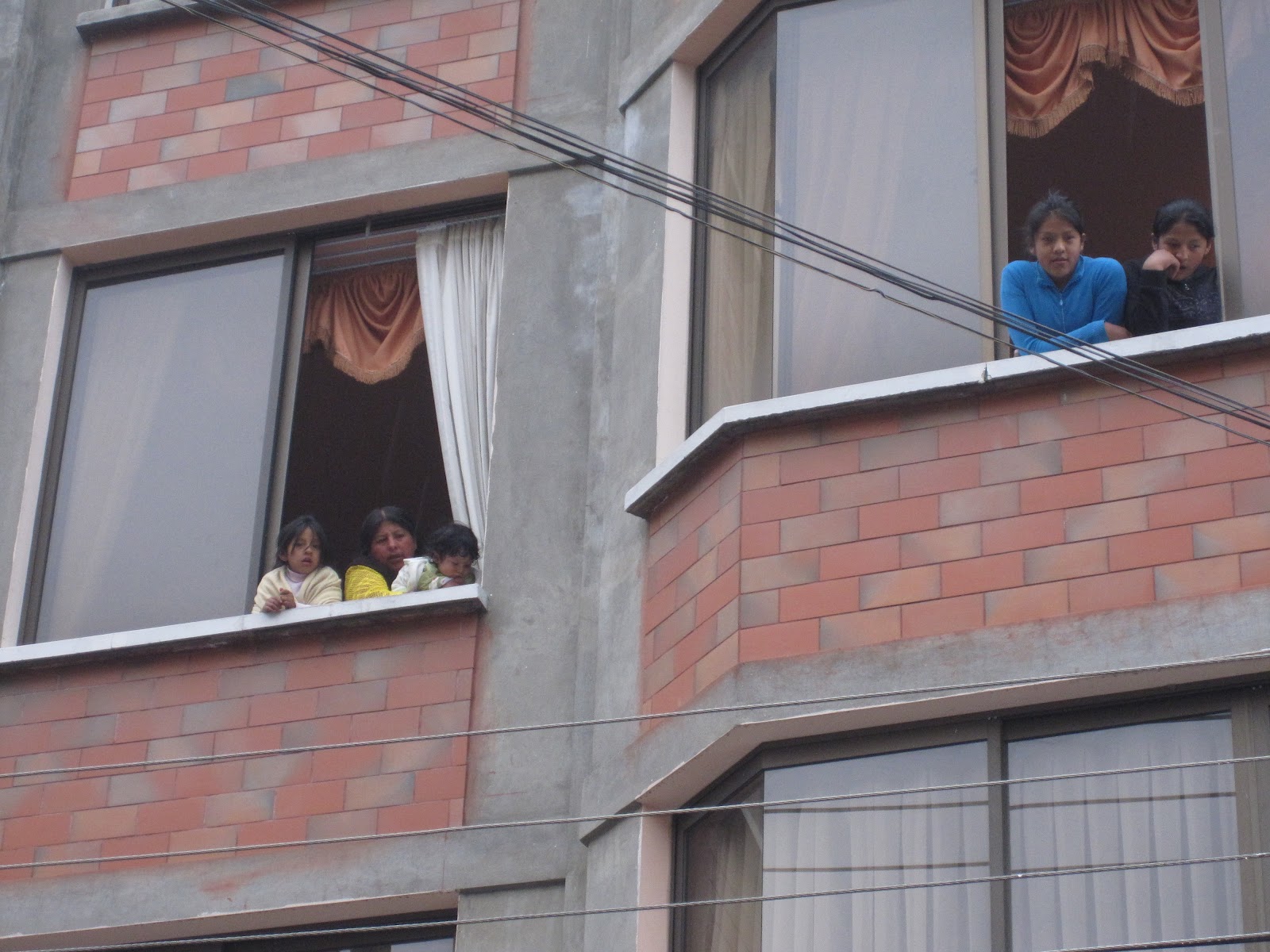
Bolivians looking down to the street from their apartments.  Most families have little to give, but lots of love to share.  

Thursday, April 5, 2012

Expectations - Updated

I commented on expectations in a previous post.  Really, I had no idea what to expect from La Paz or Bolivia.  Here's a follow up to some of my previous thoughts.

Language: Yes, the people here speak Spanish, but of course, there's a different dialect and special Bolivian phrases that I'm starting to learn.  I'm filling my ears and head with medical Spanish all day long right now, and it's quite overwhelming.  I've learned so much in 3 days (charts = carpetas, daily notes = valoraciones.  Why not "notas"?  I mean, come on!)

People: Yes, there are many with dark hair and eyes, most very nice.  The general clothing styles vary enormously.  While walking down the street, I've passed an Aymaran woman with the long colorful skirt, flat shoes, thick socks and Bowler hat with braids, then seen a contemporary business person in a suit and tie while walking by a group of young girls in cute boots and jeans.  Most I've found very friendly and helpful.  I work with another resident and a "medical doctor" (which means he's finished med school and intern year and is now a general doctor until he picks a residency).  They are super nice and SO patient with me.  Today Roxana helped me find food for a late lunch and then hailed the RIGHT kind of taxi for me since we got out of work late.  What an awesome Boliviana!

Transportation: There are 5 modes of transportation here: bus (a green "microbus"/school bus), minibus (small van where people pile in and ride together to main destinations), regular taxi (you pick up other travellers and all pay about 3 Bolivianos/ 50 cents), radio taxi (what we think of as a normal taxi), or of course walking.  Seat belts and stop signs are rareities.  Be ready to crash into a person or another vehicle at any moment. 

City: Most streets are paved, but many closeby my house are stone (making car rides super loud ).  The picture above is from the main part of the city (I live in the Southern Zone with newer buildings).  The streets curve and wind around mountains and hills.  Buildings in most of the city are spray painted with graffiti and look very old.  Just walking is a task in most of the city because of the hills and stone streets.  

Hospitals/Healthcare: On my first day of work, I pulled up to the front door of the hospital not knowing what to expect.  As I walked through the front doors at 7:30am, there was a waiting room filling up with people waiting to be seen in clinic.  There are 4 floors in the hospital, the third floor being the pediatrics floor.  I've found that, in general, the patients are cared for the best that can be expected given a huge lack of resources.  I've only worked in the NICU/PICU up to this point.  Each ICU room houses about 3 babies.  There is a huge effort to encourage hand washing at the hospital, so each of these rooms has sinks with soap and alcohol gel.  Gloves are hard to find. 

The general pediatrics floor has multiple large rooms (about 4-5) that house 6-7 patients per room.  There are no curtain dividers for rooms, and only 1 private room on the floor.  The "respiratory" room had 6 children all with respiratory infections placed together with room only for a chair between beds where their mothers sat.  Nobody was wearing a mask.  Another large room housed 6 postpartum mothers with their newborns at the bedside and as many other family members that you could fit.  Parents, family, and other patients line the hallway.  On my first day, my attending doctor was pulled aside multiple times just in the hallway for questions about kids (not in the hospital or clinic), and was writing prescriptions and handing them out.  He is a busy, busy man!  (He's less busy the past 2 days since the private doctors in the city stopped their strike.)  Early in the morning, the "interns" (med students in their 6th year of school) are busily typing their daily notes on typewriters, filling the hall with the loud clicks and clacks.  The ICU has one computer that we use for some of our notes.

In the NICU, there is one "certified nurse" (RN) for all the patients.  We have had up to 12 patients.  That's right.  Today, I realized how outstanding this lady is.  We had a very busy day and the RN was literally running around, sweating, trying to do all the work that she could.  She has about 2-3 "auxiliary" nurses that help her with tasks and 1-2 other staff members, thankfully.  In the U.S., there is typically 1 nurse to 2 ICU patients.  Other interesting facts: x-rays are reviewed by holding the small film up to the window or light and certain labs have to be driven by a med student via taxi to another hospital across town to be run by the lab.  Despite some problems with resources, the hospital has access to pediatric neurosurgery, pediatric surgery, genetics, and multiple other consultants.  People work hard to take care of their patients.  I've been impressed with the people, and saddened by the lack of resources.

Food: I've been super conservative with food choices.  The only Bolivian food I've tried was some sort of country fried steak with french fries and today an egg and cheese tortilla with a boiled potato.  Hmm...  Otherwise, I'm sticking with peanut butter and yogurt.  We'll see how this goes...

Wednesday, April 4, 2012

A Comparison: Part 2 - La Paz

Currently I'm sitting in a house that belongs to a family originally from Spain who came to Bolivia many years ago as a part of Spain's conquest of this area of South America.  They have a brick house with a full, metal security gate and barbed wire around the top of a surrounding brick wall.  On the grounds are 2 small guest homes and a nice yard with flowers and a stone driveway.  There's a car parked out front, that usually stays parked as walking or taking taxis is the norm here. 

My room is spacious - with a bed, a desk, a closet, and my own bathroom.  The shower has hot water immediately.  The heating for my room comes from a convection-type heater along the bottom of the wall.  My window looks out directly into a construction project for a new large apartment complex.  During the daytime hours I hear the sounds of people hammering, shouting, working to build another tall building to surround this old home (think about the movie Up - the setting is just like that with the tall buildings around a small house).  There's one light in the room - hanging from the middle of the ceiling.

Outside I can hear the construction and sounds of taxi's honking (they honk as they fly through intersections - no such things as stop signs around here apparently).  Dogs are everywhere!  They have ability to roam as they'd like.  They walk on the streets next to you in groups of 2-3 most of the time, all different sorts.  Apparently many are pure bred according to the people who live here. 

I'm about to go out to the street and walk 2 blocks to my friends' house where we'll take a taxi together to church tonight.  It'll probably cost 20 Bolivianos for a 15 minute ride (about $2.75).  I've got to wear shoes good enough to walk on bumpy stone streets (though most are paved with asphalt).  I'll say hi to my friends with bowler hats as we pass by each other on the sidewalk. 

Monday, April 2, 2012

Bowler hats

I keep seeing these amazing Bolivian women called the Aymara who are an indigeneous group in this country.  [This photo is not my own - I haven't snapped one of a person at this point!]  Most of them live outside of the city of La Paz in the country or in El Alto, the city to the north of La Paz where many of the poor live and migrate into La Paz to work.  The thing I love about these women, having only spoken to one in my life (the lady who works as a "maid" in our house), is their bowler hats.  They also wear flat black shoes, long flowing brightly colored skirts to below the knee, and always bright colors on a scarf that's tied around their neck or shoulders.  Their hair is long and black, almost always in 2 braids, and on top of their head sits a bowler hat like Charlie Chaplin's.  These hats in the picture above MAY fit, but most that I see are obviously too small.  But so stylish!  Many of them appear more Native American with sharper facial features.  Younger women carry babies on their backs in these brightly woven sacks with 2-3 children at their feet.  They sell things on the street, from shirts to foods.  They are in all parts of La Paz, selling their goods that they've gathered in the field or made at home.  Bernie, the maid in our home three days a week, is an Aymara who lives in El Alto.  She has no bowler hats that I've spotted (unfortunately).

I'm starting to learn about Bolivia and it's past.  They were a colony of Spain for hundreds of years, so for most of recent history until about 20 years ago, there was a huge separation of classes (caste system) between the rich "White" people of Spanish descent, and the poor indigenous populations (like the Aymara above).  They live and work in different places - the rich with the money and poor with little of it.  There has emerged a middle class here of sorts with business people, lawyers, doctors (who get paid little with socialized medicine and most of whom have 2 jobs).  However, it is still required to pay for medical care in most places and the rich fly to other countries to get better care than what is offered in La Paz.  I'll be learning more about this in the coming days. 

Another problem here in Bolivia: money for social programs to help children without parents, street children, teen mothers, better education for children of the working poor.  Thanks to Foundation Arco Iris (Rainbow Foundation) which was started about 15-20 years ago, many of these programs have been started and continue on with funding through the Foundation.  It runs on volunteers and attempts at self-sufficiency with bakeries and clothes-making businesses.  The Hospital where I'll start tomorrow is another part of this Foundation's work.  

I tip my bowler hat to all of you - thanks for reading!  And more to come....

Sunday, April 1, 2012

Fish out of water

That's what I felt like in the Ketal supermercado yesterday.  I needed some snacks and bottled water, so what better way to branch out into a country and culture than to go shopping in my local supermarket?  Turns out, this had to be one of nicest markets in La Paz.  I've found out that my community (Zona Sur and the Calacoto community) houses some of the wealthiest in Bolivia, making it a bit safer for us to live here.  Don't get too excited - this was no Publix or Harris Teeter...or Food Lion, or Wal-Mart.  Here's where the fish out of water comes in...

I walk into a nice appearing establishment and was happy to find that they provided buggies AND bags for carrying!  (In Spain, buggies weren't an option, and bags...you paid for those!  Even the plastic ones!)  What small conveniences that we take for granted!  I walked straight into the section with the worst reputation of them all: the dreaded produce.  [See previous blog.]  This area of the grocery store felt off limits.  Almost as if I needed a mask or gloves or something.  (The meat guy did wear a mask though...is that normal?)  I looked around, just out of curiosity, and I was only deterred by the pile of apples that increased my doubts about my previous apple ingestion.  So I moved on, noting only the mountains of potatoes.  [Fast fact: out of 600 different types of potatoes in the world, Bolivia grows 400!  They love them here!]

Then I turned to find the meat section.  More reminders popped into my head: "Don't eat ANY raw meat.  Only totally cooked!  You don't want to be sick for weeks!" In front and all around me all of a sudden appeared piles of plastic wrapped RAW MEAT!  Yikes!  Chicken, pork, beef, more beef.  The meat guy with the mask then walked out, and I immediately fled, not to return.  Not even lunch meat would be acceptable to buy at this point.  Next up: cheese.  I'll be honest.  I had no idea what I was looking at.  The only thing familiar was the Philadelphia cream cheese box (3 times more expensive than the other items).  Otherwise, the random assortment of letters for the trademark with a "QUESO" under it left me baffled.  Is it goat cheese?  Cow cheese?  Soft, hard, in between?  Do I just eat it alone?  Where are the slices?    Do they eat those here?

Keep walking.  Yogurt seems safe to me for some reason.  I found some reasonably priced peach and strawberry yogurt with a Spanish label and put 2 in the cart.  First items in, check.  OH!  And bottled water!  Found it on the end of the aisle - that was easy!  I put an 8 pack in the buggy and then I felt like a bonafide Bolivian grocery store shopper, stuff in my cart and all.  All I need now is a bowler hat.  (See coming blog post.)

I then proceeded to wander around every aisle, just to see what they had.  I had found out that 1 dollar is equal to 7 Bolivianos, which makes everything in the store seem super expensive.  First thought: "What?  $35 for granola bars?!?!"  Not the case, but I still couldn't bring myself to buy them.  I later eyed the juice from afar, but didn't go for it.  I found out this morning that juice comes either in large boxes or small packets, like Hot Pocket-sized things.  The lady I live with gave me some of these little packs for breakfast.  Thinking it was yogurt, I popped open the bag with my fork and pushed out the contents when all of this pineapple juice went rolling on my plate.  Then I thought, well maybe there's chunks of pineapple in here??  I then pushed harder and only more juice came out!  Looking around the kitchen, not knowing what to do next, I just picked up my plate and tried to drink the juice.  Yeah.  Mom would be proud of me for this one. 

Conclusion: My tribute to coca tea.  This pic is from my welcome pack from the team of people working here.  Thanks to Diamox and coca tea, I'm still altitude sickness-free.  Thank you coca!

Saturday, March 31, 2012

Apples and altitude

I've never thought about altitude sickness until this trip.  I've been to Colorado for a few days to ski, but I've never climbed Mt. Everest or lived in the Alps like Julie Andrews.  La Paz is apparently 16,000 feet high.  I'll do my stats, but I'm pretty sure that's higher than the Rockies.  These are the Andes!  Last night as we flew in, it was hard to see the mountains, but as we drove into La Paz from it's neighboring city El Alto, it was a downward spiral around mountains and cliffs with beautiful lights from the homes that dotted the hills. 

Altitude sickness apparently is due to the decreased about of oxygen in the air.  It's your body adapting to this change.  Your pH gets thrown off I think as your body becomes more acidic and your bone tries to make more red blood cells to carry oxygen around to your organs.  It manifests as nausea/vomiting, headache, weakness, fatigue.  The cure for Americans: prevention with a diuretic called Diamox (pre-treats you make you more acidic beforehand so you can catch up sooner), then hydration.  The cure for Bolivians: coca tea.  That's right, it's the plant that ends up becoming cocaine when super concentrated.  It's actually illegal in the U.S. (so I won't be bringing any home).

True confession: I'm currently on my 4th glass of this today.  (Per the recommendations of the "gringos" who are from the U.S. now living here. "Drink as much as you can!" they say.  "It only helps!")  It's just like green tea, no big.  And currently I'm headache and nausea free.  The only symptom I JUST had was muscle pain on the way home from the store carrying 2 2-liter waters and another 8 pack of bottled water.  I'm better now! (as I sip on my tea...)  More to come on my grocery store experience today....

On the drive in from the airport, my new friends Gwen and John were giving me all the hot tips on living in Bolivia (including coca tea).  One big piece of advice: don't eat cut fruit.  If you REALLY want it, you have to wash it in a bleach bath first.  Wow.  I'd heard that bananas or things with skin may be ok, right?  Next tip: to be safe, don't eat meat that's in any way not cooked fully.  Better yet just to become a vegetarian at this point maybe.  AND watch out for that running water!  Bottled water only, even for tooth brushing.  Yikes!  I knew I was sunk when the first thing I did before bed this morning was put a big handful of sink water in my mouth.  I froze.  Oops.  I immediately spit it out and rinsed with that life saving bottled water!  Hope that did the trick.  :)  This morning I stood staring at my breakfast: bread, honey, butter, and, you guessed it, green apples.  Apples.  Did they say anything about these?  Are these off limits?  I pondered this thinking first, well, I'm just not going to do it.  Then hunger and the thought of a fresh apple overwhelmed me and I went for it: took the apple to the sink, washed it with [bottled] water, cut it into wedges, and carefully ate only the insides of the wedges.  No touching that skin!

Hope that worked. 

Arrival!

Hi all!
I'm here!  And tired... so not much blogging to be done right now.  I got a taxi ride with my friends from the church here who met me SUPER early at the airport this morning.  It took a while to organize getting my tourist visa ($135 dollars cash on demand plus multiple forms), but I made it out as a legal Bolivian tourist with all my luggage and now am in a comfortable home in the Zona Sur (South Zone) of La Paz.  I plan on sleeping for a while.  More to come... (The Internet works!)